What is actually under the carpet
A recurring moment in this work is pulling back a corner of carpet in a Fayetteville or Prairie Grove house and finding a floor nobody in the household knew was there. Carpet went down over hardwood in enormous quantities from the 1960s through the 1980s, and the irony is that it protected what it covered.
What comes up is frequently better material than money can buy now. Early growth heart pine, tight ringed and dense. Old red oak cut in narrow strip. Wide plank pine in the oldest houses. These trees grew slowly in conditions that no longer exist commercially, and the wood reflects it.
Where these floors are in NWA
The historic housing stock here is concentrated. Washington-Willow and Mount Sequoyah in Fayetteville have the deepest and oldest inventory, much of it early 1900s. Downtown Rogers along Walnut and Poplar has Craftsman and Victorian homes largely from 1910 to 1935 with original narrow red oak strip.
Beyond those, Siloam Springs around the Sager Creek historic district holds early homes with heart pine, and Prairie Grove kept its historic core rather than redeveloping it. Bentonville has Craftsman bungalows around the Square. Each of these markets has its own typical floor and its own typical problems.
Restoration is not the same as refinishing
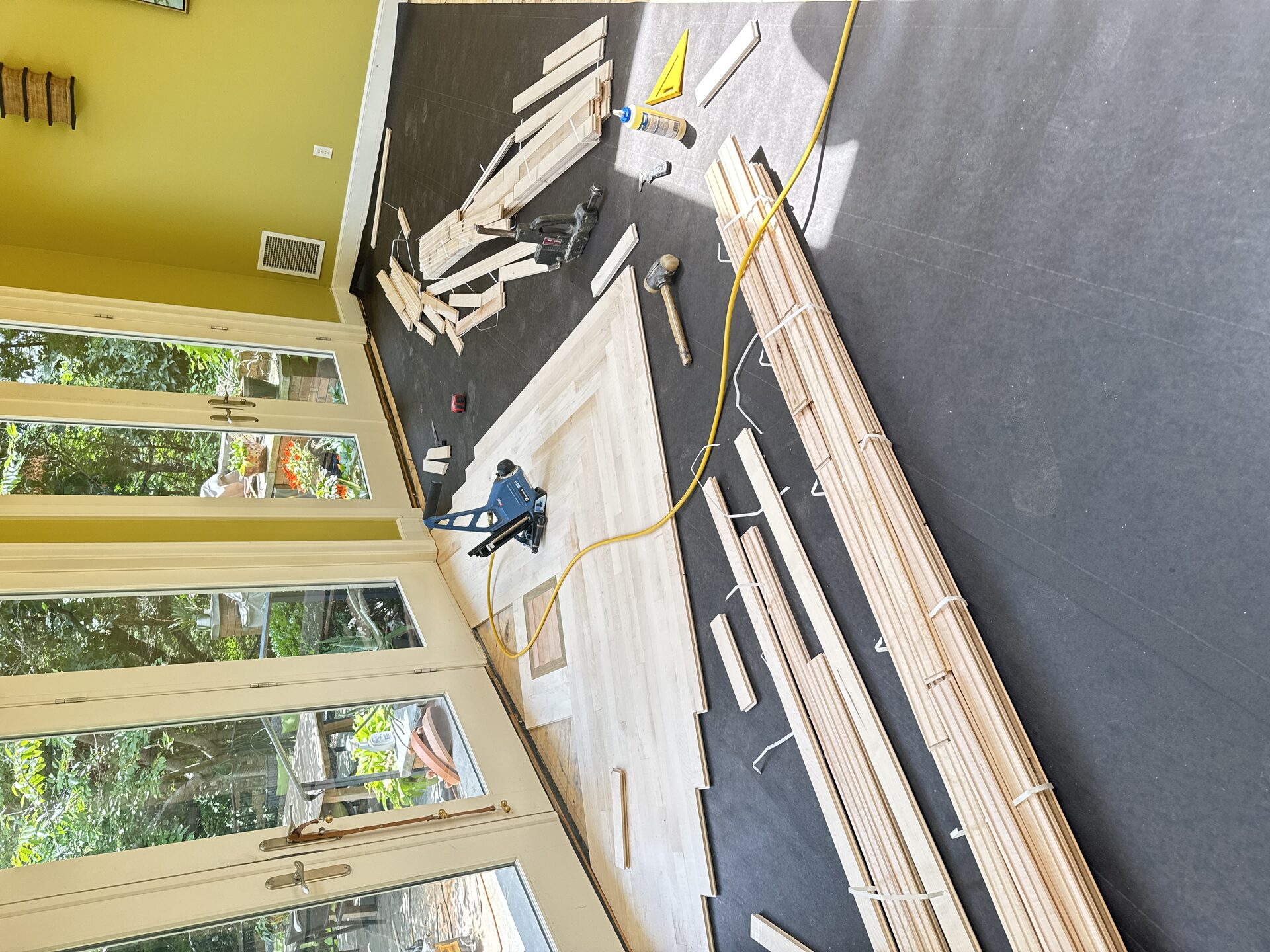
Refinishing is a surface operation: sand, stain if wanted, coat. Restoration includes refinishing but starts earlier and involves more judgement. It means assessing what is structurally sound, sourcing replacement material that matches species and cut and width, weaving new boards into the existing field, filling gaps that a century of movement has opened, and dealing with old fastener holes and previous repairs.
The governing principle is that original material stays wherever it can. A board that is cosmetically poor but structurally sound gets kept and refinished. Replacement is for boards that have genuinely failed.
Heart pine needs a different hand
Pine is softer than oak, and that changes everything about how it is sanded. It burnishes easily, meaning an aggressive or careless pass will polish the surface in a way that then refuses stain. It also takes stain unevenly without proper sealing first, and the result of getting that wrong is a blotchy floor that can only be fixed by sanding again and losing more of a finite material.
A crew that only ever works oak will get a pine floor wrong. We sample colour on site, on the actual floor, before committing to anything, and on historic work that step is not negotiable.
How thin is too thin
The hard limit on any restoration is remaining thickness above the tongue. Solid hardwood can be sanded until the tongue is approached, and past that the floor loses structural integrity and starts to break at the edges. Many historic floors have already been sanded once or twice in their lives.
So the first real question on any old floor is how much wood is left. We check at a threshold, a floor vent, or a stair nosing where the edge is visible. Sometimes the honest answer is that a floor has one sanding left and should be treated as the last one, which changes what finish we recommend and how we advise maintaining it afterwards.
Character versus perfection
This is the conversation worth having before work starts. An old floor sanded to modern flatness and coated in high gloss loses much of what made it worth saving. Saw marks, slight variation between boards, patina around a hearth, the evidence of a hundred years of use, those are the reasons to keep an original floor rather than install a new one.
Our default on historic work is to preserve character: keep the gentle irregularity, leave sound patina where it reads as age rather than damage, and finish in satin or matte rather than gloss. But it is your house. Some owners want crisp and uniform, and that is a legitimate choice. It just needs to be a choice, made deliberately, rather than a default nobody discussed.
Preservation guidelines
In designated historic districts there can be guidelines affecting exterior work, and owners occasionally worry these extend to floors. Interior flooring is generally less constrained than exterior fabric, but if your home is in a district with an active review process it is worth confirming before work begins.
Our approach is preservation minded regardless: save original material, source period appropriate replacements, and avoid irreversible interventions. That posture tends to satisfy guideline requirements as a side effect of simply being the right way to treat an old floor. See our repair and restoration service for the full scope.
Common questions
Can 100 year old hardwood floors be refinished?
Usually yes, and they are often better material than anything available new. The limiting factor is remaining thickness above the tongue, which we check at a threshold or vent before quoting.
How many times can a hardwood floor be sanded?
It depends on the original thickness and how much has already been removed. Solid three quarter inch flooring can typically take several sandings across its life. Many historic floors have already had one or two, so the remaining budget is smaller.
Is refinishing heart pine different from oak?
Yes, materially. Pine is softer, burnishes easily under a sander, and takes stain unevenly unless sealed correctly first. It needs a lighter touch and on site colour sampling before committing.
Should I keep the character or make it look new?
That is your call and worth deciding deliberately. Our default on historic floors is to preserve character and finish in satin or matte, because the patina is usually the reason the floor is worth saving. A crisp uniform result is achievable if that is what you want.
Do you replace missing boards in old floors?
Yes. We source replacement stock matched to species, cut, and width, weave it into the existing field rather than patching a rectangle, and finish the whole area together so the repair blends.
Talk to us. Heritage Hardwood Floors offers free in-home estimates across Northwest Arkansas. Call (479) 426-5337 or request an estimate.